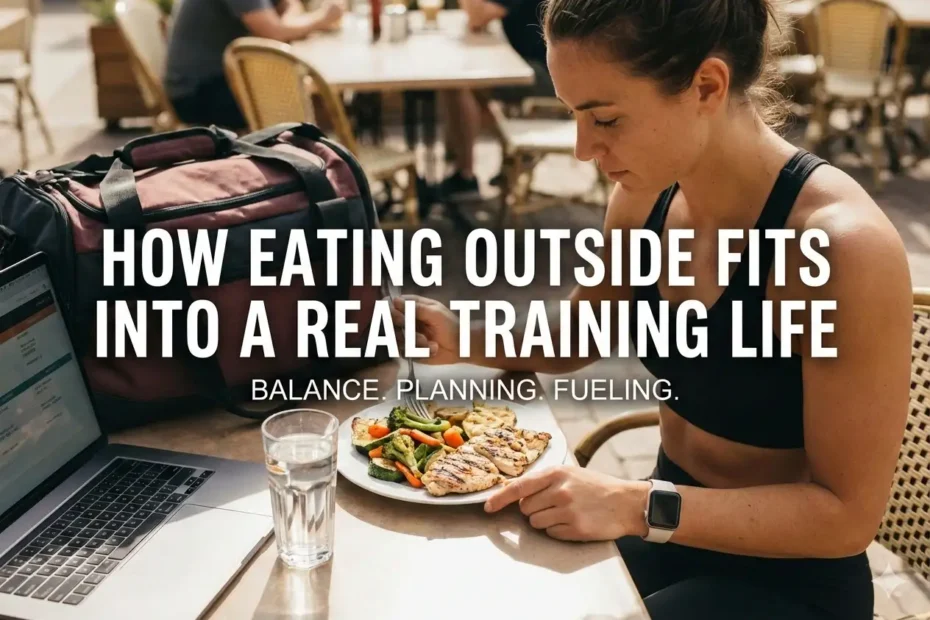
People who train regularly often carry a quiet tension around food. It shows up when a dinner invitation lands on a training day or when a long workday ends with no energy left to cook. Somewhere between protein shakes and social life, eating outside becomes loaded with meaning it does not deserve.
The truth is simpler than most gym culture makes it. Eating outside does not cancel progress. It does not undo workouts. It does not require an apology. What matters is how often it happens, when it happens, and whether it fits into the rhythm of how you train and recover. Most frustration comes from treating food as a moral issue instead of a practical one.
Training changes how your body uses food, but it does not turn you into a machine. Your muscles respond to timing, not guilt. They respond to patterns, not single meals. Once you understand that, eating outside stops feeling like a threat and starts feeling like a choice you can manage without stress.
Training Changes the Rules, but It Does Not Erase Them
Going to the gym gives you more room to breathe with food, but it does not remove boundaries. When you train, especially with resistance or high intensity, your body becomes better at directing calories toward repair instead of storage. Muscles pull in nutrients. Glycogen gets replenished. Hunger signals shift. This is why people who train consistently can eat more than sedentary people without gaining fat.
What often gets lost is that this advantage is not evenly spread across the week. Your body does not treat every day the same way. A hard training session creates a window where food is used productively. A rest day does not. When people say they train hard but still feel stuck, the issue is often not how much they eat, but when.
Many gym-goers unknowingly flatten their week. They eat lightly after workouts and heavily on days off, usually because life gets in the way. Over time, that pattern dulls results. Nothing dramatic happens. Progress just slows quietly. Understanding this difference is the foundation for eating outside without frustration.
The Difference Between Random Eating Out and Planned Eating Out
Eating outside becomes a problem when it happens without intention. Not intention in the sense of discipline or control, but intention in the sense of awareness. Random eating out tends to stack without anyone noticing. One lunch turns into another. A late dinner follows a long day. Suddenly eating outside feels constant even if it was never planned that way.
Planned eating out feels different in the body. It usually happens after training or on a day where movement has already been high. The rest of the day is simpler. There is less snacking, less grazing, less emotional eating. Satisfaction is higher because the meal fits into the day instead of interrupting it.
This difference matters more than food choice. A well-timed restaurant meal can support training better than a poorly timed homemade one. When eating outside becomes part of the structure instead of a reaction to fatigue or stress, it stops feeling like damage control.
Training Days Are Where Eating Outside Often Works Best
Training days give you the most flexibility with food, especially when the meal happens after the workout. This is when the body is most receptive. Muscles are depleted. Appetite is honest rather than emotional. Food feels grounding instead of heavy.
Many people fear eating outside after the gym because portions look large or menus feel indulgent. In reality, this is often the safest time to eat a substantial meal. Energy stabilizes. Recovery improves. Sleep tends to be deeper. The body uses what it is given instead of storing it away.
Problems arise when people flip this pattern. They rush through a small meal after training and then eat heavily later at night when the body is winding down. Over time, this creates a mismatch between effort and fuel. Eating outside after training aligns effort with reward in a way that feels natural rather than forced.
Rest Days Are Where Eating Outside Needs More Awareness
Rest days are quieter, and that is exactly why eating outside can add up there. Without training, calorie needs drop even if hunger does not. Social meals, longer dinners, and alcohol tend to land on these days because schedules open up.
Nothing dramatic happens from one rest-day dinner. The issue is repetition. When rest days become the default time for heavy meals, progress slows without any clear reason. People feel like they are doing everything right because workouts are consistent, but results feel muted.
Eating outside on rest days works best when meals are simpler and portions are less ambitious. This does not require restriction. It requires honesty about what the body actually needs on a day without training. When rest-day meals match rest-day demands, everything feels smoother.
Frequency Without Guilt Looks Different for Different People
People often want a number. How many times per week is okay. The answer depends on how often you train, how much muscle you carry, and what phase you are in. Someone lifting four or five times per week can handle eating outside more often than someone training once or twice.
Beginners feel the impact of eating outside faster because their bodies are still adapting. Advanced lifters tolerate it better because their routines are stable and their muscle mass is higher. Bulking phases allow more freedom. Cutting phases demand more attention.
What matters most is consistency. Eating outside once or twice every week rarely causes issues. Eating outside frequently without adjusting anything else usually does. The body responds to patterns, not exceptions.
Social Meals Are Not the Same as Convenience Meals
There is a difference between eating outside because you want to and eating outside because you are exhausted. Social meals tend to be slower, more satisfying, and easier to remember. Convenience meals are often rushed, eaten distractedly, and followed by more hunger.
This distinction matters for people who train because satisfaction influences recovery. A meal that feels complete reduces the urge to snack later. A meal eaten under pressure often does the opposite.
When eating outside is social, it tends to regulate itself. When it is reactive, it tends to escalate. Recognizing which one you are doing helps more than tracking calories ever will.
Where You Eat Shapes How Much You Eat Without You Noticing
Environment influences intake in quiet ways. Lighting, noise, seating, and pacing all change how quickly you eat and how full you feel. Fast environments encourage speed. Comfortable environments encourage lingering.
Sitting in restaurant booths, for example, often leads to longer meals and more relaxed pacing, which can be enjoyable but also makes it easier to keep eating past hunger if ordering is not deliberate. None of this is good or bad. It simply means environment matters.
When you know a place encourages long meals, you can order accordingly. Awareness turns environment from a trap into a tool.
Ordering Without Turning Dinner Into a Performance
You do not need to announce dietary rules or interrogate the menu. Ordering well at restaurants is quieter than that. It usually starts with choosing a protein source that feels substantial. Once that anchor is in place, the rest of the meal falls into line naturally.
Carbohydrates support training. They do not need to be avoided, just chosen with some restraint. Fats add flavor and satisfaction, but stacking them unknowingly is where calories hide. Sauces, dressings, and cooking methods matter more than people think.
Dessert is not mandatory. Neither is skipping it. The key is deciding rather than drifting. Alcohol deserves similar treatment. One drink rarely disrupts training. Several often affect sleep and appetite the next day, which is where progress quietly leaks away.
Eating Outside While Cutting Fat Feels Different
Cutting phases narrow margins. Hunger is louder. Recovery feels slower. This is where eating outside needs more structure, not more stress. Meals outside work best when they replace another meal instead of stacking on top of the day.
Protein becomes even more important here. Liquid calories become less forgiving. Late meals hit harder. None of this requires perfection, but it does require awareness.
Many people fail cuts not because they eat outside, but because eating outside loosens everything else. One planned meal per week usually works. More than that requires deliberate adjustment elsewhere.
Eating Outside While Gaining Muscle Can Actually Help
Bulking phases are more forgiving, but they still benefit from structure. Eating outside can support muscle gain when meals are substantial and predictable. Large portions with enough protein help meet higher calorie needs without constant cooking.
Problems arise when eating outside becomes chaotic. Too much fat, inconsistent timing, and poor digestion slow progress. A bulk works best when meals feel heavy but not sloppy. Eating outside during a bulk works when it feels intentional rather than impulsive.
Maintenance Is Where Most People Actually Live
Most gym-goers spend more time maintaining than cutting or bulking. Maintenance is subtle. Weight stays stable. Energy feels decent. Progress is slow but steady.
In this phase, eating outside two or three times per week often works well as long as training stays consistent. Maintenance fails when small indulgences stack quietly without adjustment. Awareness keeps maintenance smooth. Panic ruins it.
Why Banning Eating Outside Backfires
Strict rules rarely last. People who ban eating outside often rebound. Social friction builds. Food becomes charged. Training starts to feel like punishment instead of support.
Long-term gym success favors people who integrate real life. Eating outside is part of adult life. Learning how to do it without derailing training is a skill worth developing. The goal is not control. It is calm.
How Athletes Actually Handle Eating Outside
Professional athletes eat outside more than people assume. They just do it with structure. Meals follow training. Orders repeat. Sleep stays protected. One meal does not trigger panic. They adjust the next meal instead of spiraling. That mindset matters more than food choice.
Adjusting Training Instead of Restricting Food
Sometimes the better move is not eating less, but moving more. If you know you will eat outside this week, adding volume or intensity can balance intake naturally. Extra steps, a longer session, or a conditioning block can align effort with food. This is not punishment. It is alignment. Food and training are levers. Pulling one does not require locking the other.
Progress Lives in Patterns, Not Meals
One restaurant meal does nothing. Repeated habits do. When eating outside becomes predictable, it stops being stressful. When it becomes emotional, it deserves attention.
People who succeed long-term are not stricter. They are steadier. They know when to eat outside, when to eat simply, and when to move on without guilt. That balance is what keeps training alive year after year.